Biography
The life of
Jaya Prakash Narayan
Born in a river village in 1902, dead in Patna in 1979, and for most of the fifty years in between refusing the offices that were offered to him. This is the life set out in the order it happened, with the context that explains why each turn was taken.
Vital record
- Full name
- Jayaprakash Narayan; also transliterated Jaya Prakash Narayan. Family name Srivastava, which he did not use publicly.
- Born
- 11 October 1902, at Sitabdiara — a village at the confluence of the Ganga and the Ghaghara, on the Bihar–United Provinces boundary.
- Parents
- Harsu Dayal Srivastava, a junior official in the state canal department, and Phul Rani Devi.
- Married
- 1920, to Prabhavati Devi (1906–1973), daughter of the Bihar Congress leader Braj Kishore Prasad. They had no children.
- Education
- Patna Collegiate School; Patna College (left, 1921); Bihar Vidyapeeth; the universities of California (Berkeley), Iowa, Wisconsin and Ohio State, where he took an M.A. in sociology in 1929.
- Office held
- None in independent India. He held party posts — notably general secretary of the Congress Socialist Party — but never governmental office.
- Principal honours
- Ramon Magsaysay Award for Public Service, 1965. Bharat Ratna, 1999, awarded posthumously.
- Died
- 8 October 1979, at Patna, aged 76, of complications following kidney failure.
01 — Early life
Sitabdiara in 1902 was a large village of the Gangetic plain, prosperous enough by local standards and precarious in the way that river villages are: land appeared and disappeared as the channels moved. Harsu Dayal Srivastava, JP’s father, worked for the state canal department, a modest but secure government post that took him away from home for stretches at a time. The family was Kayastha — a service and record-keeping caste with a long tradition of literacy and government employment — and education was assumed rather than debated.
JP was the fourth of their children. What the biographies agree on about his childhood is unremarkable and probably true: a bright boy, close to his mother, at ease in the countryside, sent away young because the village school could take him no further. At about nine he left for Patna.
02 — Education, and the year he walked out
At the Patna Collegiate School he lived in a students’ hostel, won prizes for his Hindi, and moved on in due course to Patna College. He was there, nineteen years old and weeks away from his examinations, when Gandhi’s Non-Cooperation Movement asked Indian students to abandon government-aided institutions.
He walked out. It was not a small thing to do — the examinations were the gateway to exactly the kind of career his family expected of him — and he later described the decision as the first he had made entirely on his own. He enrolled instead at Bihar Vidyapeeth, one of the national institutions founded to receive students who had left the colonial system. Rajendra Prasad, later the first President of India, was among its founders.
The marriage had already taken place. In October 1920 he had married Prabhavati Devi, the daughter of Braj Kishore Prasad, a Gandhian lawyer and one of the senior Congress figures of Bihar. Prabhavati was fourteen. When JP left for the United States two years later she went to live at Gandhi’s Sabarmati Ashram, where she took a vow of celibacy — a decision made in Gandhi’s presence and one that shaped the rest of their marriage. They remained married for fifty-three years, and apart for a great deal of it.
03 — The United States, 1922–1929
In 1922 JP sailed for California. He had almost no money, no scholarship and no family support for the venture. What followed was seven years of working his way through four American universities.
He picked grapes in the Californian vineyards, worked in fruit-canning plants, washed dishes in restaurants, laboured in a garage, and took whatever seasonal work the academic calendar allowed. He enrolled at the University of California, Berkeley; when fees rose he moved to the University of Iowa, then to the University of Wisconsin, and finally to Ohio State University, where he completed a master’s degree in sociology in 1929 with a thesis titled Social Variation.
The intellectual event of those years was Marxism. At Wisconsin he read Das Kapital and the literature of the Russian Revolution, and encountered the writings of M.N. Roy, the Indian communist then working in the Comintern. He came away persuaded of two things that would stay with him for the next quarter-century: that the national question in India could not be separated from the agrarian one, and that Marxism offered the only systematic account of how societies actually change.
He intended to stay for a doctorate. Word reached him that his mother was seriously ill, and his money had in any case run out. He returned to India towards the end of 1929.
He arrived home a trained sociologist, a convinced Marxist, and completely unknown — and within three years he was in a colonial prison.
Editorial summary — not a quotation04 — Return to India
Prabhavati was at the ashram; Gandhi, who had come to know her well, was the reason JP first met the Congress leadership as something other than a stranger. But the decisive relationship was with Jawaharlal Nehru, who was drawn to the young man’s combination of American training and Marxist conviction and brought him into the Congress organisation. By most accounts JP was given charge of the Congress’s labour research work — a job that suited a sociologist and put him in contact with trade unionists across northern India.
The Civil Disobedience Movement of 1930–34 swept him up as it swept up everyone else. In 1932, with Gandhi and most of the senior leadership already imprisoned, JP was arrested and sent to Nasik Jail.
05 — The freedom struggle
Nasik turned out to be the making of a political tendency. In the same barracks were Acharya Narendra Deva, Achyut Patwardhan, Minoo Masani and Ashok Mehta — men who, like JP, believed the Congress needed a socialist programme and not merely a nationalist one. The Congress Socialist Party emerged directly from those conversations, formally constituted in 1934 with JP as its general secretary.
The CSP was not a rival party. It was a bloc within the Congress, arguing for the nationalisation of key industries, the abolition of landlordism without compensation, the organisation of peasants and workers, and a clear commitment that independence would be followed by economic reconstruction. Its argument with Gandhi was about class; its argument with the communists was about the Congress; its argument with the Congress right was about property. JP set out the case in Why Socialism? in 1936, the most widely read of his early writings.
The war changed the terms. JP opposed any unconditional Indian contribution to a British war effort and said so publicly; he was imprisoned for it, held for a period at the Deoli detention camp, and was in Hazaribagh Central Jail when the Quit India resolution was passed in August 1942 and the entire Congress leadership was arrested overnight.
On the night of 9 November 1942 — Diwali — JP and five others went over the wall of Hazaribagh jail: Yogendra Shukla, Suraj Narayan Singh, Ramnandan Mishra, Gulab Chand Gupta and Shaligram Singh. What followed made his reputation. For the better part of a year he moved through northern India in disguise, organising a clandestine resistance, and set up training for a volunteer force — the Azad Dasta — from across the Nepal border. He was recaptured at Amritsar in September 1943, held in Lahore Fort under interrogation that later accounts describe as severe, then transferred to Agra Fort. He was released, with Ram Manohar Lohia, in April 1946.
The freedom struggle file treats this period in detail.
06 — The socialist period
He came out of prison in 1946 the most popular Congressman in India after Gandhi and Nehru, and spent the next decade discovering how little that was worth.
He did not take office in the interim arrangements or in the government formed at independence. In 1948, when the Congress amended its constitution to bar members from belonging to other parties, the socialists left and formed the Socialist Party. It contested the first general election of 1951–52 with enormous public affection and very few seats. In September 1952 it merged with J.B. Kripalani’s Kisan Mazdoor Praja Party to form the Praja Socialist Party.
In 1953 Nehru opened talks with him. JP put forward a programme of conditions — on land reform, on planning, on administrative and electoral change — as the price of socialist cooperation. The talks broke down. Whether they failed because Nehru would not concede enough or because JP asked for what no governing party could deliver is still argued over; both readings are set out in the legacy file.
07 — After independence: the long disillusionment
By 1954 he had concluded that parliamentary party politics, as practised in India, could not produce the transformation he wanted. Parties competed for office; winning office required money and organisation; money and organisation required exactly the interests that a socialist programme was supposed to displace. The conclusion was not that democracy had failed but that it had been captured by its own machinery.
At the Sarvodaya conference at Bodh Gaya in April 1954 he announced jeevandan — the gift of his life — to Vinoba Bhave’s Bhoodan movement, which was walking from village to village asking landowners to give away land for redistribution. In 1957 he formally renounced party politics altogether. He was fifty-five, and he had another twenty-two years to live.
08 — Sarvodaya
The Sarvodaya years are the least dramatic and the most revealing. He walked in the land-gift campaign. He argued for gramdan, in which a whole village placed its land under collective village trusteeship rather than individual gift. In 1959 he published A Plea for Reconstruction of Indian Polity, proposing a participatory structure built upward from village councils through district and state tiers — a constitutional alternative rather than a slogan.
He also took on work nobody else would. In 1964 he joined the Nagaland Peace Mission with the Reverend Michael Scott and the Assam chief minister B.P. Chaliha, which produced a cease-fire in a conflict the Indian state had been fighting for years. He argued publicly for a negotiated settlement in Kashmir and was attacked for it across the political spectrum. In 1969–70 he lived and worked at Musahari in Muzaffarpur district, in a countryside then being contested by armed left-wing groups, and wrote about the experience in Face to Face with unusual candour about his own failure to shift entrenched landholding power. In 1971 he travelled abroad to argue the case of the refugees from East Bengal. In 1972 he presided over the public surrender of dacoits in the Chambal ravines, persuading men who had been hunted for years to give themselves up rather than be killed.
The Ramon Magsaysay Award for Public Service came in 1965, in the middle of this period. Accounts of his life also record that he declined the Padma Bhushan offered to him in 1957, on the ground that a man engaged in public service should not accept state honours.
09 — The later political role
Prabhavati died on 15 April 1973. He was seventy, newly alone, and his own health was beginning to fail.
In March 1974 a student agitation in Bihar over corruption, prices and unemployment turned violent, and the students’ committee asked JP to lead it. He agreed on the condition that the movement remain nonviolent and that it aim at something larger than the resignation of a state ministry. On 5 June 1974 at the Gandhi Maidan in Patna he gave the call that defined his last years:
“Sampoorna kranti ab naara hai, bhavi itihas hamara hai.”
Translation: “Total revolution is now our slogan; the history to come is ours.”
The movement spread out of Bihar. On 25 June 1975, at the Ramlila Maidan in Delhi, JP addressed a mass rally and called on the police and the armed forces to refuse orders that were illegal or immoral. That night a state of Emergency was proclaimed. He was arrested in the early hours of 26 June and detained; his kidneys failed in custody; he was released on health grounds on 12 November 1975 and remained on dialysis for the rest of his life.
10 — Final years
He was too ill to campaign in the election of March 1977, and his influence on it was nonetheless decisive. It was largely at his insistence that four opposition parties dissolved themselves into a single Janata Party rather than contesting separately. The Janata Party won; Indira Gandhi lost her own seat; Morarji Desai became Prime Minister on 24 March 1977, chosen with JP and J.B. Kripalani acting as arbiters between the claimants.
The government he had helped to create began breaking apart almost at once over questions of personality, of the loyalties its constituent parties had brought with them, and of what to do about the Emergency’s architects. Desai resigned in July 1979. JP, on dialysis in Patna, watched it come apart and said publicly that he was disappointed. In March 1979 a false report of his death reached Parliament, which mourned him before the error was discovered — an episode he survived with a good deal more humour than the government did.
11 — Death and national response
Jaya Prakash Narayan died at Patna on 8 October 1979, three days before his seventy-seventh birthday. The government declared national mourning. He was cremated at Patna, and the crowds that came were, by every contemporary account, immense.
He left no political organisation of his own, no office, no property of consequence and no dynasty. What he left is an argument, a set of institutions founded by people he had trained, and a vocabulary for democratic dissent that Indian public life has drawn on ever since. In 1999 the Republic conferred on him the Bharat Ratna, its highest civilian honour — the only state honour he was in no position to refuse.
Continue
The events summarised here are set out at length in the files on the freedom struggle, Sarvodaya, Total Revolution and the Emergency. The published works this account draws on are listed under sources.
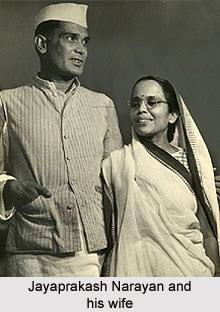
JP with Prabhavati Devi. The caption printed on the source image reads “Jayaprakash Narayan and his wife”.
A marriage of fifty-three years
Prabhavati Devi, 1906–1973
She married him at fourteen and spent much of the marriage away from him — at Sabarmati with Gandhi, in the Gandhian constructive-work movement, and later in her own right as a figure in the women’s and Sarvodaya circles of Bihar. She was imprisoned herself during the national movement.
Her vow of celibacy, taken at the ashram, was made without JP’s prior agreement and caused him real distress at the time; he accepted it, and their partnership afterwards was political and personal in equal measure. She died of cancer on 15 April 1973, thirteen months before the Bihar movement began. Those close to him recorded that the movement of his last years was undertaken by a man who had just lost the person he consulted about everything.