The life & ideas of Jaya Prakash Narayan
A life in the
search for freedom.
He spent fifty years arguing that freedom was not a thing a country wins once. Independence, he insisted, was only the beginning of the question.
Jaya Prakash Narayan — Jayaprakash Narayan, or simply JP — was an independence activist, a Marxist turned democratic socialist, a Sarvodaya worker, and, at seventy-one, the reluctant leader of the largest movement against a sitting Indian government since independence. He held no office in free India, and was offered several. This archive follows that refusal through his writings, his movements and the arguments they left behind.
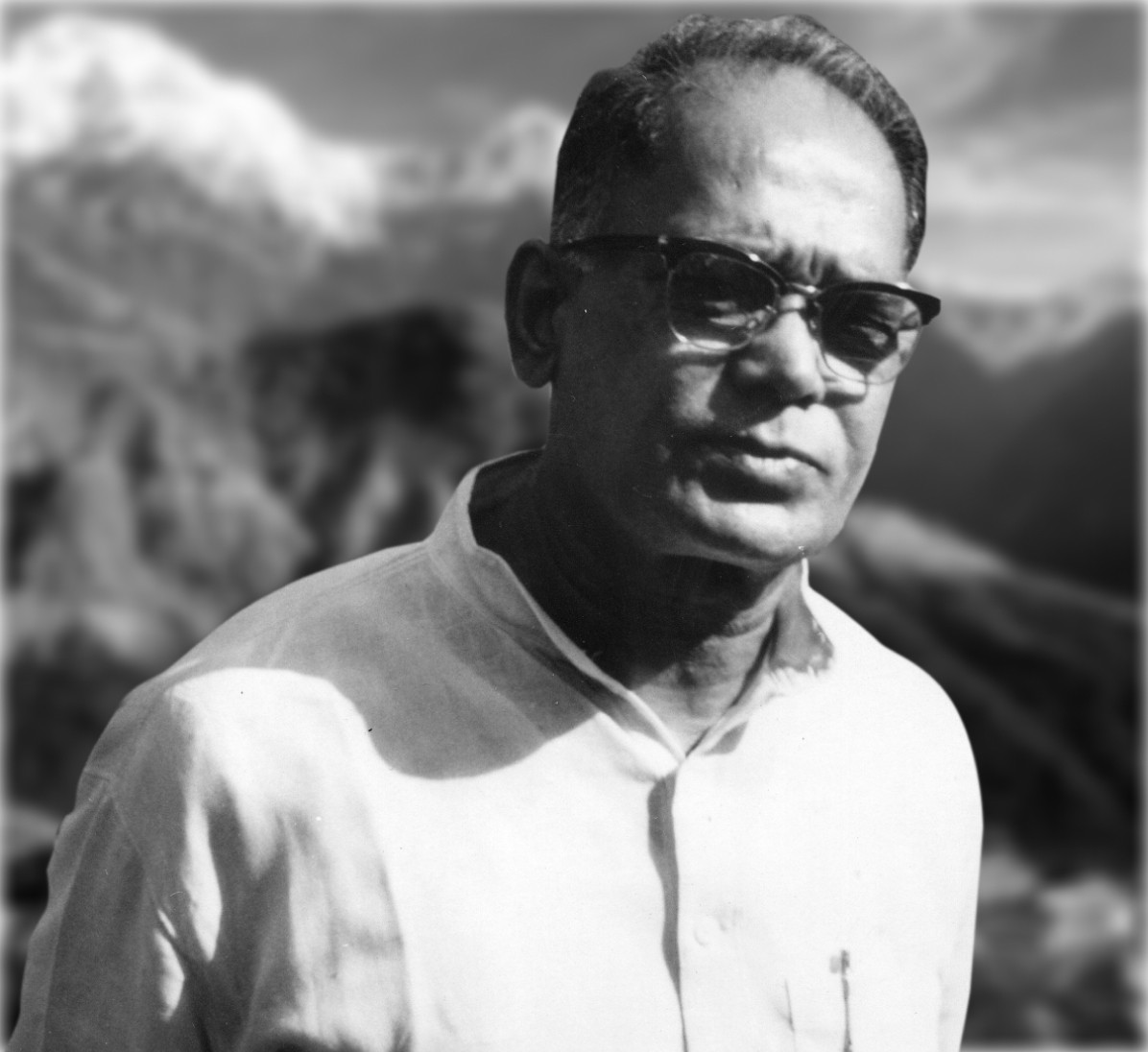
Studio portrait of Jaya Prakash Narayan, photographed against a painted backdrop of the kind common in Indian studios of the period.
Archive copyReference use
An introduction
The man who kept refusing power
In the winter of 1929 a young man in his late twenties stepped off a ship at Bombay carrying a master’s degree in sociology from an American university, a habit of reading Marx, and no clear plan. He had gone to the United States seven years earlier as a student who could not pay his fees, and had put himself through Berkeley, Iowa, Wisconsin and Ohio State by picking fruit, working in canning plants, washing dishes and labouring in garages. He came back to a country in the middle of a civil disobedience campaign, and to a wife who had spent most of their marriage living at Gandhi’s ashram.
Jawaharlal Nehru brought him into the Indian National Congress almost immediately. Within three years he was in prison. Within five he had helped found the Congress Socialist Party, a bloc that stayed inside the Congress but argued that political independence without economic transformation would leave most Indians exactly where they were. It is the argument he spent the rest of his life restating in different vocabularies.
What made him a national figure was not an office but a jailbreak. In November 1942, with most of the Congress leadership behind bars and the Quit India Movement leaderless, he went over the wall of Hazaribagh Central Jail with five others and spent the next ten months organising an armed and clandestine resistance from the Nepal border. He was recaptured in 1943 and held, and interrogated harshly, in Lahore Fort. By the time he was released in April 1946, he was one of the best-known revolutionaries in India — and, to a generation of students, the most romantic.
Independence arrived, and he declined to govern. That decision — repeated, deliberate, and costly — is the hinge on which the rest of his life turns.
Editorial summary — not a quotationAfter 1947 the socialists left the Congress and JP led them into opposition. He was, by common consent, the most popular politician in India who was not in government, and the Socialist Party did badly at the polls anyway. Nehru offered cooperation, then something close to a place in the cabinet; the talks of 1953 collapsed over how far the Congress was willing to go on land, on planning and on the machinery of the state. In 1954, at a Sarvodaya gathering in Bodh Gaya, JP announced jeevandan — the gift of his life — to Vinoba Bhave’s Bhoodan movement, which was asking landowners to give away land voluntarily. Three years later he formally left party politics altogether.
The two decades that followed are the least remembered and, for understanding him, the most important. He walked in the Bhoodan campaign. He drafted a constitutional alternative built upward from village councils rather than downward from Delhi. He joined a peace mission to Nagaland. He worked in the agrarian conflict of Musahari in north Bihar and wrote honestly about failing there. He persuaded dacoits in the Chambal ravines to surrender publicly rather than be shot. He was, in the language of the time, no longer a politician at all.
And then, at seventy-one, with his wife recently dead and his own kidneys beginning to fail, he was asked by a student committee in Patna to lead an agitation against corruption and unemployment in Bihar. He agreed on one condition: that it stay nonviolent. On 5 June 1974, at the Gandhi Maidan, he told an enormous crowd that what was needed was not a change of ministry but sampoorna kranti — total revolution. Within a year the movement had gone national, the Prime Minister’s election had been set aside by a High Court, and India was under a state of Emergency with JP in detention and the press under censorship.
He came out of prison in November 1975 with permanently damaged kidneys, and spent the last four years of his life on dialysis. He lived long enough to see the Emergency lifted, the opposition parties fuse into the Janata Party largely at his urging, the government defeated at the 1977 election — and then to watch that government fracture within two years. He died at Patna on 8 October 1979. Twenty years later the Republic gave him its highest civilian honour, which he was no longer in a position to decline.
Life at a glance
Seventy-seven years, in the order they happened
Every date below is drawn from the published record and is cross-referenced on the chronology, where each period is set out with its context. Where a date is disputed or imprecise in the sources, this archive says so rather than choosing one.
Born on 11 October at Sitabdiara, a village on the Bihar–Uttar Pradesh border.
Marries Prabhavati Devi, daughter of the Bihar Congress leader Braj Kishore Prasad.
Leaves Patna College during the Non-Cooperation Movement and joins Bihar Vidyapeeth.
Sails for the United States; studies while working in fields, canneries and garages.
Returns to India with a master’s degree in sociology and joins the Indian National Congress.
First imprisonment, during the Civil Disobedience Movement; held at Nasik Jail.
The Congress Socialist Party is founded; JP becomes its general secretary.
Quit India: escapes from Hazaribagh Central Jail and organises the underground resistance.
Arrested at Amritsar; held at Lahore Fort and later Agra Fort until April 1946.
Socialists leave the Congress; the Socialist Party is formed.
The Praja Socialist Party is created by merger with the Kisan Mazdoor Praja Party.
Announces jeevandan at Bodh Gaya, dedicating his life to the Bhoodan movement.
Publishes A Plea for Reconstruction of Indian Polity.
Receives the Ramon Magsaysay Award for Public Service.
Leads the Bihar movement and gives the call for Sampoorna Kranti — Total Revolution.
Arrested in the early hours of 26 June, as the Emergency begins.
Central to the merger that forms the Janata Party; the Emergency ends.
Dies at Patna on 8 October, three days before his seventy-seventh birthday.
Scroll sideways → or open the full chronology
The archive
Twelve files
Biography
A chronological life, from a village on the Ganga to the last years on dialysis in Patna.
Open file 02Chronology
Seven decades laid out era by era, with the events that shaped each period.
Open file 03Ideas & Philosophy
Marxism, democratic socialism, Sarvodaya, participatory democracy — an intellectual life that kept moving.
Open file 04Freedom Struggle
Congress, prison, the socialist wing, and the 1942 underground that made him a national name.
Open file 05Sarvodaya
The turn away from party politics towards land gift, village self-rule and voluntary action.
Open file 06Total Revolution
The Bihar movement of 1974 and what Sampoorna Kranti was actually asking for.
Open file 07The Emergency
June 1975 to March 1977: detention, censorship, and the election that followed.
Open file 08Writings & Speeches
A reading room of his principal books, pamphlets and recorded addresses.
Open file 09Legacy
What survives of his politics — and the criticisms that survive alongside it.
Open file 10Archival Gallery
Eighteen photographs and printed items, catalogued with what is and is not known.
Open file 11Sources & References
The published record this archive draws on, listed so it can be checked.
Open file 12Contact
Corrections, additions and archival enquiries.
Open fileHow this archive works
A note on evidence
JP is quoted a great deal on the internet, often in words he never used. This archive is built to be checkable, and it would rather be thin than invented.
Quotation is labelled
Where his own words appear, they are marked Direct quotation and carry a date, place and source. Everything else is marked as summary or paraphrase. Nothing is attributed to him that cannot be traced.
Numbers are omitted, not guessed
Crowd sizes, prison durations, membership figures and vote counts appear only where the published record supports them. Where it does not, this archive describes the scale in words and says the figure is not established.
Photographs are not re-captioned
Each image in the gallery records what is actually known about it. Where a date, place or photographer is unrecorded, the catalogue entry says “not recorded” instead of supplying one.
Disagreement is kept in
He was criticised in his lifetime from the left, the right and the centre, and historians still disagree about 1974–77. Those criticisms are set out on the legacy page rather than edited away.
Why it is still read
An argument that outlived its author
JP’s central claim was that a democracy which reduces its citizens to voters once every five years will hollow out, whoever wins. He wanted power pushed downward — to the village, the locality, the assembly of people who actually live with the consequences of a decision. He never built the institution that would have carried it, and he knew it.
What he did build was a language for democratic dissent that did not depend on holding office: the right to be told the truth by a government, the right to organise against it, and the duty of citizens to refuse illegitimate orders. In 1976, from detention and afterwards, he helped found what became the People’s Union for Civil Liberties. That institution outlived him, and so did the argument.
Read the ideas, follow the movement of 1974, or look at the twenty-one months that followed it.
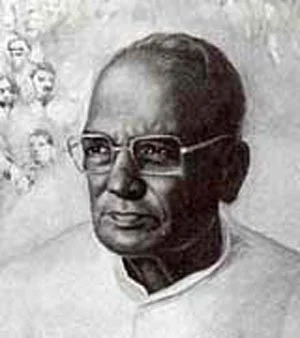
A painted portrait of JP, the artist placing sketched crowd faces behind his shoulder — the image of a leader defined by the people around him rather than by an office.