The Jaya Prakash Narayan Archive Sitabdiara 1902 — Patna 1979
Jaya Prakash Narayan Life · Ideas · Movements · Legacy

Chronology

A chronology,
1902–1979

Seventy-seven years, set out period by period. Where a date is given differently in different sources, the entry says so rather than choosing one; where a figure cannot be established, it is left out.

File JPN/CHR/002Entries 47Periods 7Span 1902–1979

Filter by period

Filtering is a convenience only — with JavaScript disabled the whole chronology remains on the page in order, and every entry stays readable.

1902–1920

Origins — a river village, a school hostel, an early marriage

190211 October

Born at Sitabdiara

Born to Harsu Dayal Srivastava, a junior official of the state canal department, and Phul Rani Devi, in a village at the meeting of the Ganga and the Ghaghara. The village straddles the modern Bihar–Uttar Pradesh boundary; sources variously place it in Saran district, Bihar, and in Ballia district, Uttar Pradesh.
c.1911

Sent to Patna for schooling

Admitted to the Patna Collegiate School and housed in a students’ hostel, some distance from home. He was a prize-winning student of Hindi.

Note — Exact year of admission is given differently across accounts

1920October

Marriage to Prabhavati Devi

Married Prabhavati Devi, then fourteen, daughter of Braj Kishore Prasad — a Gandhian lawyer and a senior Congress figure in Bihar. The marriage lasted fifty-three years, until her death in 1973.

1920December

The national context shifts

The Congress session at Nagpur adopted Gandhi’s programme of non-cooperation, including the withdrawal of students from government-aided institutions. The decision reached Patna within weeks.

1920s

Departure — leaving college, and seven years in America

1921

Leaves Patna College

Abandoned his studies weeks before his examinations in response to the non-cooperation call, and enrolled instead at Bihar Vidyapeeth, one of the national institutions founded to receive students who had left the colonial system.

1922

Sails for the United States

Left for California with almost no money and no scholarship. Prabhavati went to live at Gandhi’s Sabarmati Ashram, where she took a vow of celibacy.

1922–28

Berkeley, Iowa, Wisconsin

Worked his way through successive universities — picking grapes, canning fruit, washing dishes, labouring in a garage — moving when fees rose. At Wisconsin he read Marx and the literature of the Russian Revolution, and encountered the writings of M.N. Roy.

1929

M.A. in sociology, Ohio State University

Completed a master’s degree with a thesis titled Social Variation. He intended to continue to a doctorate; news of his mother’s illness, and the end of his money, brought him home.

1929late in the year

Returns to India and joins the Congress

Brought into the Indian National Congress organisation by Jawaharlal Nehru. By most accounts he was given charge of the Congress’s labour research work.

1930s

The socialist — prison, a party within a party, a programme

1930–34

The Civil Disobedience Movement

The salt satyagraha and the campaigns that followed drew in the whole Congress organisation and filled the colonial prisons with its leadership.

1932

First imprisonment: Nasik Jail

Arrested during Civil Disobedience and imprisoned at Nasik, where his fellow prisoners included Acharya Narendra Deva, Achyut Patwardhan, Minoo Masani and Ashok Mehta. The Congress Socialist Party emerged from those conversations.

1934

The Congress Socialist Party is founded

Constituted as a socialist bloc within the Congress rather than a rival to it, with JP as general secretary. Its programme: nationalisation of key industries, abolition of landlordism, organisation of peasants and workers, and a commitment that independence be followed by economic reconstruction.

1936

Why Socialism? published

The most widely read of his early writings, and the fullest statement of his Marxist position. See Writings & Speeches.

1939

The war, and the refusal of unconditional support

India was declared a belligerent by the Viceroy without consultation. JP opposed any unconditional Indian contribution to the British war effort and said so in public meetings.

1940s

Underground — the jailbreak, the forts, and independence

1940

Imprisoned for an anti-war speech

Convicted and jailed for public opposition to Indian participation in the war.

1941–42

Deoli detention camp, then Hazaribagh

Held for a period at the Deoli detention camp and later moved to Hazaribagh Central Jail, where he was confined when the Quit India resolution was passed in August 1942 and the Congress leadership was arrested overnight.

19429 November

Escape from Hazaribagh Central Jail

On Diwali night JP went over the prison wall with five others — Yogendra Shukla, Suraj Narayan Singh, Ramnandan Mishra, Gulab Chand Gupta and Shaligram Singh.

1942–43

The underground and the Azad Dasta

Moved through northern India in disguise, organising clandestine resistance, and set up training for a volunteer force from across the Nepal border. The colonial government offered a reward for information leading to his capture.

Note — The amount of the reward is cited differently in different accounts and is not stated here

1943September

Recaptured at Amritsar

Arrested at Amritsar and held in Lahore Fort under interrogation later described as severe, then transferred to Agra Fort.

1946April

Released

Released along with Ram Manohar Lohia, after sustained pressure from Gandhi and Nehru. He emerged one of the best-known figures of the national movement.

194715 August

Independence — and no office

He took no position in the government formed at independence, and declined the offers that were made to him. He never held governmental office at any point in his life.

1948

The Socialist Party is formed

The Congress amended its constitution to bar members from belonging to other parties. The socialists left and constituted themselves as an independent Socialist Party.

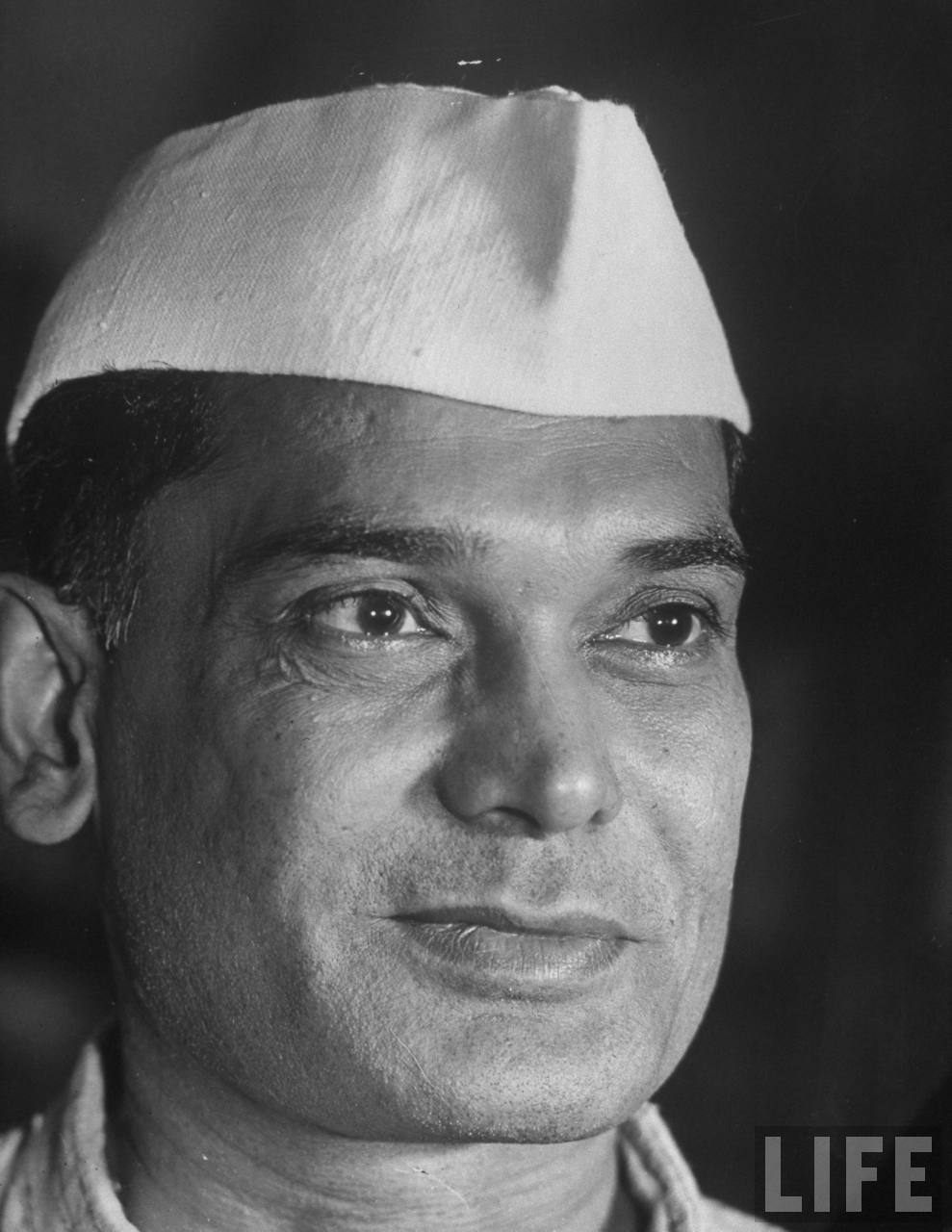
Close portrait of a younger Jaya Prakash Narayan wearing a white Gandhi cap

JP in a Gandhi cap — the photograph most often used to represent him in the years around independence.

Plate JPN/GAL/05
Date Not recorded in the source file
Credit The reproduction carries a LIFE magazine watermark; photographer not identified in the source file
Presentation Full frame, uncropped

Reading the middle of the life

The twenty years nobody remembers

Popular memory of JP has two chapters: the jailbreak of 1942 and the movement of 1974. Between them lie almost three decades in which he was arguably at his most original — and almost entirely out of the news.

Those are the years of the Bhoodan walk, of the constitutional proposals of 1959, of Nagaland, of Musahari, of the Chambal. They are also the years in which he worked out the position that made 1974 possible: that democracy is not a machine for producing governments but a practice that has to be exercised by citizens, continuously, at the level where they live.

The periods below cover that stretch.

1950s

The turn — from party politics to jeevandan

1951–52

The first general election

The Socialist Party contested with great public affection and won very few seats — a result that began JP’s reconsideration of electoral party politics.

1952September

The Praja Socialist Party

Formed by the merger of the Socialist Party with J.B. Kripalani’s Kisan Mazdoor Praja Party.

1953

Talks with Nehru break down

Nehru opened negotiations on socialist cooperation with the government. JP set out conditions on land reform, planning, and administrative and electoral change. The talks failed. Historians still disagree about which side was unwilling to move.

1954April

Jeevandan at Bodh Gaya

At a Sarvodaya conference JP announced the gift of his life to Vinoba Bhave’s Bhoodan movement, which was asking landowners to give land voluntarily for redistribution.

1957

Renounces party politics

Withdrew formally and permanently from party political activity. Accounts of his life also record that he declined the Padma Bhushan offered to him in this period.

1959

A Plea for Reconstruction of Indian Polity

His constitutional alternative: a participatory polity built upward from village councils through district and state tiers, rather than downward from a single national centre.

1960s

Public work — Nagaland, Musahari, and an award

1961

Swaraj for the People and A Picture of Sarvodaya Social Order

Two statements of the Sarvodaya position written for a general readership.

1964

The Nagaland Peace Mission

Served with the Reverend Michael Scott and the Assam chief minister B.P. Chaliha on a mission that produced a cease-fire in a conflict the Indian state had been fighting for years.

1965

Ramon Magsaysay Award for Public Service

Conferred by the Ramon Magsaysay Award Foundation, Manila.

1960sthroughout

Kashmir

Argued publicly and repeatedly for a negotiated political settlement in Kashmir that took account of Kashmiri opinion, and was attacked for it from across the political spectrum.

1969–70

Musahari

Lived and worked at Musahari in Muzaffarpur district, in a countryside then being contested by armed left-wing groups. He wrote about the experience — including his own inability to shift entrenched landholding power — in Face to Face.

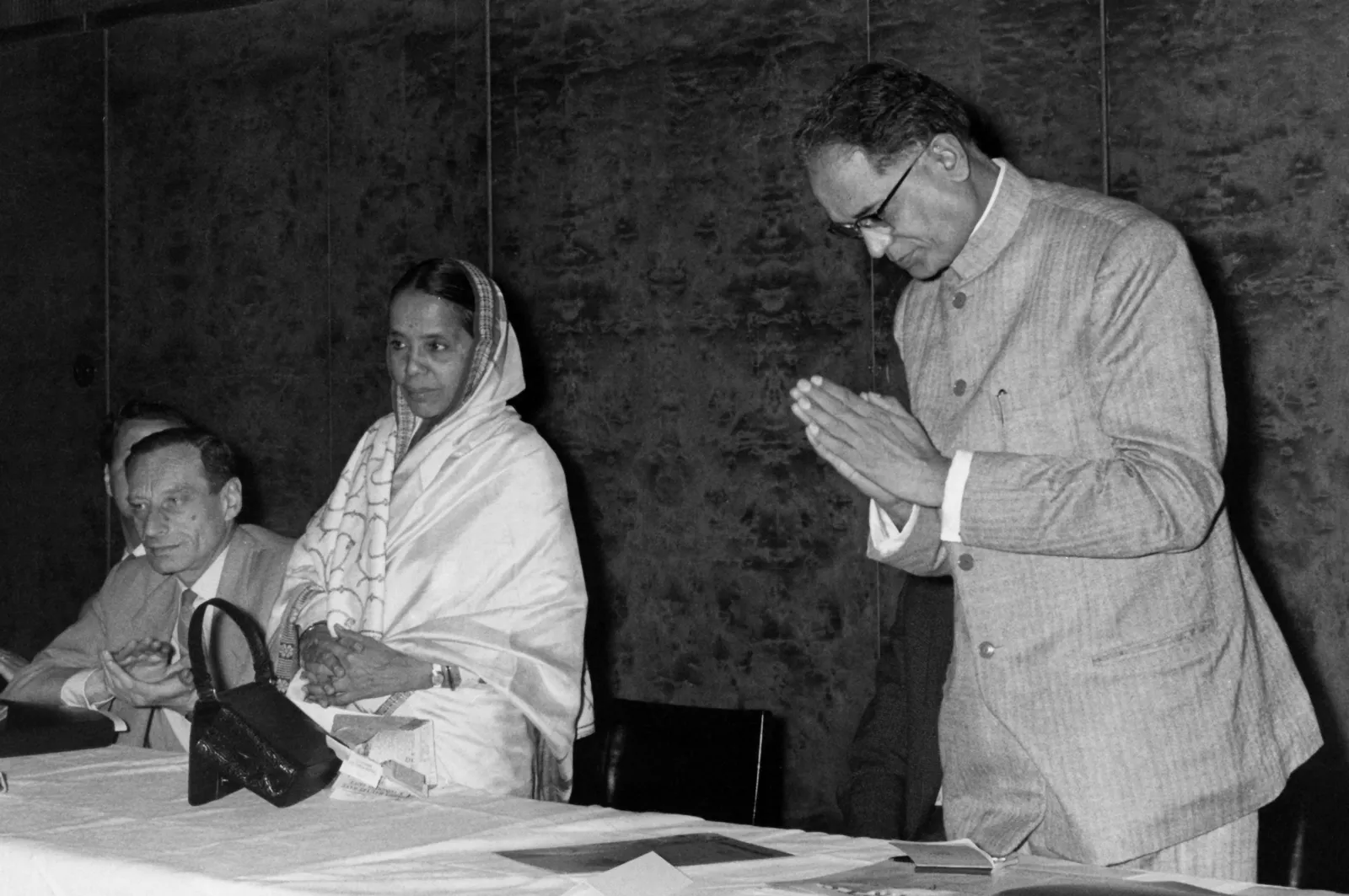
Photograph of a man in a kurta greeting with folded hands beside a seated woman in a sari at a conference table

An international socialist occasion. The source file is titled “Jayaprakash Narayan attends the 8th SPD Party Congress, 22 May 1958, in Stuttgart”; that title is reproduced here as supplied and has not been independently verified by this archive.

Plate JPN/GAL/06
Date as supplied 22 May 1958
Place as supplied Stuttgart, West Germany
Verification Caption reproduced from the source file title; not independently confirmed

The socialist international

A politics with foreign correspondents

The Indian socialists of JP’s generation were part of an international conversation. They corresponded with European social democrats, took part in the Asian Socialist Conference, and argued about the Soviet Union with people who had made the same argument in Berlin and Vienna.

That connection matters for understanding his break with Marxism. He did not abandon it because he stopped caring about inequality; he abandoned it because he became convinced — watching the states that called themselves socialist — that concentrating power in order to redistribute it produced a new concentration rather than a redistribution.

The argument is set out in Ideas & Philosophy.

1970s

The last decade — Total Revolution, the Emergency, and the end

1971

The case of East Bengal

Travelled abroad to argue the case of the refugees from East Bengal before foreign governments and publics during the crisis that preceded the creation of Bangladesh.

1972

The Chambal surrenders

Presided over the public surrender of dacoits in the Chambal ravines of central India, persuading men who had been hunted for years to give themselves up rather than be killed. Figures for the number who surrendered vary between accounts and are not stated here.

Note — Surrender ceremonies took place at Jaura, Madhya Pradesh

197315 April

Prabhavati Devi dies

Her death from cancer left him alone thirteen months before the Bihar movement began.

197418 March

The Bihar agitation begins

A student demonstration at the Bihar Legislative Assembly in Patna, over corruption, prices and unemployment, ended in violence and police action. The students’ committee approached JP to lead the movement.

19748 April

The silent march

JP led a silent procession through Patna — the movement’s public commitment to nonviolent method, and the condition on which he had agreed to lead it.

19745 June

The call for Total Revolution

At the Gandhi Maidan in Patna he told an enormous meeting that what was required was not a change of ministry but sampoorna kranti — total revolution across the social, economic, political, cultural, intellectual, educational and spiritual life of the country. See Total Revolution.

19745 November

Struck during a procession in Patna

JP was hit by a police lathi during a demonstration in Patna; those around him shielded him from further blows. He was seventy-two.

197512 June

The Allahabad High Court judgment

Justice Jagmohanlal Sinha set aside Indira Gandhi’s 1971 election from Rae Bareli on grounds of electoral malpractice and barred her from elected office for six years. The judgment transformed a regional agitation into a national crisis.

197525 June

Ramlila Maidan

At a mass rally in Delhi, JP called on the police and the armed forces to refuse orders that were illegal or immoral, and the poet Ramdhari Singh Dinkar’s line “Singhasan khaali karo ki janata aati hai” was recited from the platform.

197525–26 June

The Emergency is proclaimed

A state of internal Emergency was proclaimed under Article 352 on the night of 25 June. Mass arrests of opposition figures followed in the early hours of 26 June; JP was among the first taken. Press censorship was imposed.

197512 November

Released on health grounds

His kidneys had failed in detention. He was released and remained dependent on dialysis for the rest of his life. His Prison Diary, kept during the detention, was published in 1977.

1977January–March

The Janata Party and the election

Elections were announced and the Emergency relaxed. Largely at JP’s insistence, four opposition parties dissolved themselves into a single Janata Party. It won; Indira Gandhi lost her own seat; Morarji Desai became Prime Minister on 24 March 1977, chosen with JP and J.B. Kripalani acting as arbiters.

1979March

A premature announcement

A false report of JP’s death reached Parliament, which mourned him before the error was discovered.

19798 October

Death at Patna

Died at Patna, aged 76, three days before his seventy-seventh birthday, of complications following kidney failure. National mourning was declared. He was awarded the Bharat Ratna posthumously in 1999.

Continue through the archive