The Jaya Prakash Narayan Archive Sitabdiara 1902 — Patna 1979
Jaya Prakash Narayan Life · Ideas · Movements · Legacy

The Emergency

Twenty-one months

Between 25 June 1975 and 21 March 1977 India was governed under a proclaimed state of Emergency, with fundamental rights suspended, the press censored and the opposition in prison. JP was arrested on the first night and came out with his kidneys destroyed.

File JPN/EMG/007Period 25 June 1975 – 21 March 1977JP’s detention 26 June – 12 November 1975Ended by The general election of March 1977

The Emergency is the most contested episode in the history of the Indian Republic, and it is where an archive most needs to be careful. What follows separates what was formally done, what was done in practice, what the government said its reasons were, and what historians have concluded since.

Sequence

Thirteen days in June

12 June 1975

The Allahabad High Court, in a petition brought by Raj Narain, sets aside Indira Gandhi's 1971 election from Rae Bareli on grounds of electoral malpractice and disqualifies her from elected office for six years. The judgment is stayed for a period to allow an appeal.

24 June 1975

The Supreme Court grants a conditional stay: she may remain Prime Minister pending the appeal but may not vote in the Lok Sabha.

25 June 1975

JP addresses a mass rally at the Ramlila Maidan in Delhi, calling on the police and the armed forces to refuse orders that are illegal or immoral. The poet Ramdhari Singh Dinkar's line “Singhasan khaali karo ki janata aati hai” — vacate the throne, the people are coming — is recited from the platform.

Night of 25 June 1975

A proclamation of Emergency under Article 352 of the Constitution, citing a threat to the security of India by internal disturbance, is signed by President Fakhruddin Ali Ahmed. The Union Cabinet is informed the following morning.

Early hours of 26 June 1975

Mass arrests of opposition leaders under the Maintenance of Internal Security Act. JP is among the first taken. Electricity to Delhi's newspaper presses is cut; pre-publication censorship follows.

12 November 1975

JP is released. His kidneys have failed in detention; he will depend on dialysis for the remaining four years of his life.

The measures

What the Emergency consisted of

Detention without trial

Opposition politicians, trade unionists, journalists, students and workers were detained under the Maintenance of Internal Security Act, which permitted detention without charge. Estimates of the total number detained over twenty-one months vary widely between sources and are not stated here.

Suspension of enforcement of rights

A presidential order under Article 359 suspended the right to move the courts for the enforcement of key fundamental rights, including the right to life and personal liberty.

Press censorship

Pre-publication censorship was imposed. Newspapers were required to submit copy in advance; several published blank editorial columns in protest. Foreign correspondents were expelled.

Constitutional amendment

The 39th Amendment placed the election of the Prime Minister beyond the reach of the courts. The 42nd Amendment of 1976 substantially altered the balance between Parliament, the executive and the judiciary, and extended the life of legislatures.

The courts

In ADM Jabalpur v. Shivkant Shukla (1976) the Supreme Court held by a majority that a detenu had no right to seek habeas corpus while the presidential order was in force. Justice H.R. Khanna dissented; he was superseded for the office of Chief Justice the following year. The judgment is now widely regarded, including by later benches, as among the court's gravest failures.

Coercive programmes

A mass sterilisation drive associated with the five-point programme of Sanjay Gandhi, and slum clearance operations in Delhi — the demolition at Turkman Gate in 1976 being the most notorious — produced widespread coercion, particularly of the poor. These, more than the detention of politicians, shaped the electorate's verdict in 1977.

The arguments as they were made

Two accounts of the same twenty-one months

The government’s case, as stated at the time

The proclamation cited a threat to the security of India by internal disturbance. Ministers argued that a sustained agitation calling on public servants to disobey orders amounted to an attempt to paralyse the state; that the country faced inflation, industrial unrest and an unstable external environment; and that a period of discipline was required to stabilise the economy and deliver the twenty-point programme of economic measures announced shortly afterwards. Supporters pointed to falling prices, improved industrial output and reduced strike activity during the period.

The case against, then and since

Critics argued that the proclamation followed within thirteen days of a judgment disqualifying the Prime Minister personally, that the timing was not coincidental, and that no comparable disturbance had been cited when the movement was at its height a year earlier. The suspension of habeas corpus, the censorship of the press, the amendment of the Constitution to place an election beyond judicial review, and the coercion of the poor in the sterilisation and demolition drives were, on this account, not measures of stabilisation but the removal of every check on executive power.

The electorate delivered its own verdict in March 1977. The Shah Commission of Inquiry, appointed by the succeeding government under Justice J.C. Shah, examined the excesses of the period and its reports remain a principal documentary source.

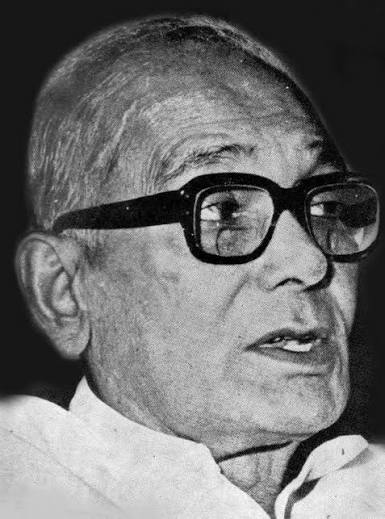
High-contrast close portrait of Jaya Prakash Narayan in heavy black-framed spectacles, speaking

JP in the last years — the high-contrast newspaper portrait by which most Indians of the period would have recognised him.

Plate JPN/GAL/13
Date Not recorded in the source file
Credit Photographer unidentified
Presentation Full frame, uncropped

JP in detention

He was arrested in Delhi in the early hours of 26 June 1975 and moved first to a rest house outside the city, then to detention at Chandigarh, where he was eventually held in a medical institute. He was seventy-two years old and already ill.

During the detention his kidneys failed. He was released on 12 November 1975 on grounds of health, and remained dependent on dialysis for the four years of life that remained to him. Whether the detention caused the renal failure or accelerated an existing condition is not something this archive can determine; what is not in dispute is that he entered detention able to travel and address meetings and left it permanently dependent on machines.

He kept a diary in detention. Prison Diary, published in 1977, is the most personal of his writings — a record of a man in his seventies, in custody, working out whether the movement he had led had brought this on the country, and concluding that the responsibility lay elsewhere. It is described further in Writings & Speeches.

He went into detention as the leader of a movement and came out as a patient. The movement continued underground without him.

Editorial summary — not a quotation

The end, and the election

On 18 January 1977 elections were announced and detainees began to be released. What JP contributed in the weeks that followed was the one thing only he could: the authority to force four opposition parties — the Congress (O), the Bharatiya Jana Sangh, the Bharatiya Lok Dal and the Socialist Party — to dissolve themselves into a single Janata Party rather than split the vote.

The election was held in March 1977. The Janata Party and its allies won a majority; Indira Gandhi lost her own seat at Rae Bareli; the Emergency was formally withdrawn on 21 March 1977. Morarji Desai was sworn in as Prime Minister on 24 March, chosen after JP and J.B. Kripalani acted as arbiters between the claimants. JP was too ill to take any part in the government, and had no intention of doing so in any case.

The verdict was not universal — the Congress held much of southern India — but in the north the rejection was decisive, and it was delivered by an electorate that included a great many people who could not read the censored newspapers and had simply seen what was done in their own localities.
What it settled

A precedent that has not been repeated

No national Emergency on grounds of internal disturbance has been proclaimed in India since. The 44th Amendment, passed by the Janata government in 1978, removed ‘internal disturbance’ as a ground and substituted ‘armed rebellion’, required the written advice of the Cabinet, and restored protections that had been suspended. Whatever else the twenty-one months produced, they produced that.

Continue through the archive