Legacy
What survives,
and what is argued
He left no party, no office, no fortune and no family in politics. What he left is a set of institutions founded by others, an argument about how democracies decay, a generation of public figures who began in his movement — and a set of criticisms that have not gone away.
Dimensions
Six things that outlived him
The People's Union for Civil Liberties
In 1976, with the Emergency in force, JP was central to the founding of the body that became the People's Union for Civil Liberties. It has operated ever since as an independent monitor of detention, custodial violence and freedom of expression, and remains among the most cited civil-liberties organisations in India. It is the most concrete institutional legacy he has.
The 44th Amendment
Passed by the Janata government in 1978, it removed 'internal disturbance' as a ground for proclaiming a national emergency and substituted 'armed rebellion', required the written advice of the Cabinet, and restored protections suspended in 1975. No national emergency on internal grounds has been proclaimed since.
The student generation of 1974
A large part of the political leadership that dominated Bihar and figured nationally from the 1980s onward entered public life through the student movement JP led — among them Lalu Prasad Yadav, Nitish Kumar and Sushil Kumar Modi, all later holders of high office. Whether the movement's values travelled with them is a separate question, treated below.
Decentralisation
The argument that democracy has to be exercised at the level where people live did not produce the communitarian polity of 1959, but it belongs to the intellectual background of the later constitutional amendments giving statutory standing to panchayats and municipalities, and to the movements for local self-government and the right to information.
A network of constructive workers
The Sarvodaya organisations and the Chhatra Yuva Sangharsh Vahini produced activists who spent the following decades on land rights, caste discrimination, rural wages and voluntary rural development, largely outside electoral politics and largely unrecorded.
The name in public places
An airport at Patna, a hospital in Delhi, a national institute, a bridge across the Ganga and a memorial at his birthplace carry his name. India Post issued a commemorative stamp in 1980. The Bharat Ratna followed in 1999.
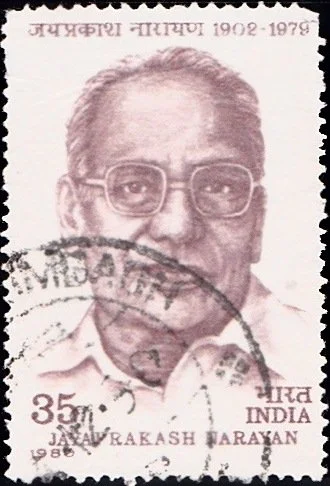
The commemorative stamp issued by India Post. The stamp itself carries his name in Devanagari and Roman script, the dates 1902–1979, the denomination of 35 paise and the year 1980; a postal cancellation runs across the face of this used example.
The shape of the memory
Public memory of JP has settled into a particular form: the incorruptible elder who stood up to authoritarian power and won. It is not false. It is incomplete in a way that would have irritated him.
What it leaves out is the twenty years of constructive work, the intellectual restlessness, the willingness to say that a position he had held for a decade had turned out to be wrong, and the fact that the government his movement produced fell apart in two years. The version of him that survives in school textbooks and anniversary speeches is a moral symbol rather than a political thinker, and a symbol is easier to invoke than an argument is to answer.
The 1999 award of the Bharat Ratna is a useful illustration. He had spent his life declining state honours — accounts of his life record that he refused the Padma Bhushan in 1957 — and the Republic conferred its highest honour on him twenty years after he was no longer in a position to say no.
Interpretations
How he is argued about
Positions are described as positions held in the literature and in public debate. This archive does not attribute a view to a named historian without a citation it can supply, and it does not invent endorsements.
The admiring reading
On this account JP is the conscience of the Republic: the one figure of the freedom generation who refused office, stayed outside the state, and was therefore in a position to say, in 1974, what nobody inside it could. His movement produced the only electoral defeat of authoritarian government in independent India, and the civil liberties institutions founded around him have outlasted every party of the period.
The strongest version of this case rests not on 1974 but on consistency: a man imprisoned by a colonial government for demanding accountability applied exactly the same standard to a national one thirty years later, at seventy-two, with his health failing.
The critical reading from the left
Critics on the left argue that JP abandoned the one framework capable of explaining Indian inequality, and replaced it with moral appeal. Bhoodan redistributed far less land than it promised; the partyless polity had no mechanism for the powerless to contest the locally powerful; and the 1974 movement mobilised the middle classes around corruption and prices while the agrarian questions of Bihar — land, wages, caste — stayed at its margins.
The sharpest version adds that by welcoming the Jana Sangh and the RSS into a movement of unquestioned moral standing, he gave the Hindu right a national legitimacy it had not previously possessed, and a route into government. His defenders answer that a movement claiming to speak for the whole people could not exclude participants for their other affiliations. It remains one of the genuinely contested questions of modern Indian history.
The critical reading from the constitutional side
A second line of criticism, made at the time by the government and since by some scholars of the period, holds that a mass movement demanding the resignation of governments holding parliamentary majorities was an attack on the electoral principle, and that calling on the police and armed forces to disobey orders was reckless whatever qualification was attached to it.
The counter-argument is that JP asked for dissolution and fresh elections rather than the seizure of power, that his appeal was confined to unlawful orders, and that the response to the movement — the suspension of habeas corpus, censorship, and the amendment of the Constitution to place an election beyond review — suggests the threat to constitutional government came from a different direction.
The argument about what happened afterwards
The Janata government JP had done more than anyone to create collapsed within two years, undone by the incompatibility of its constituent parties and by personal rivalry. He said publicly, in his last year, that he was disappointed.
A related and more uncomfortable argument concerns the later careers of the movement's alumni. A movement that began as a campaign against corruption in public life produced a political generation of which several members were themselves subsequently accused of it. Whether that indicts the movement, or merely demonstrates that institutions matter more than the virtue of individuals — which was, in a sense, JP's own argument — is a question the historical literature has not settled.
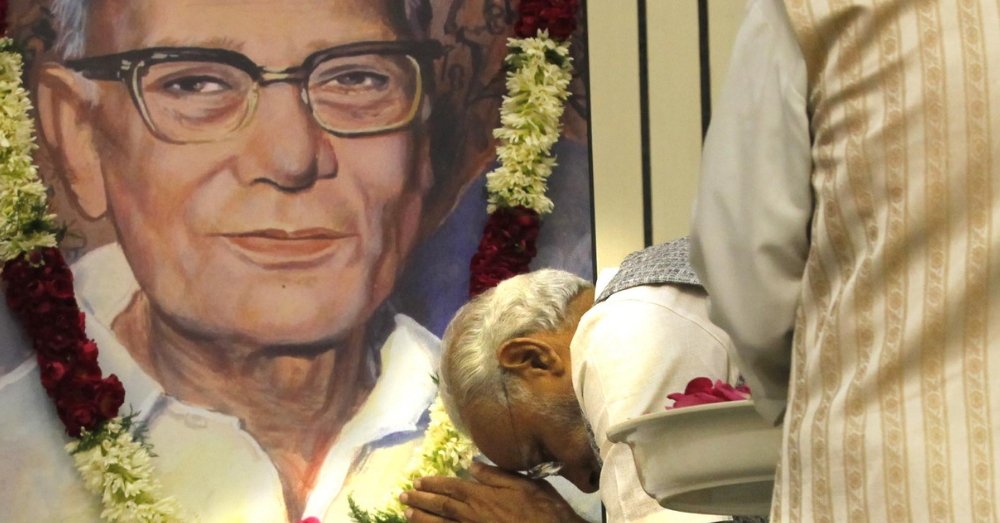
A garlanded portrait of JP and a visitor bowing before it. The occasion, the location and the identity of the person are not recorded in the source file, and are not supplied here.
The unfinished part
An argument still open
The claim at the centre of his politics was that a democracy in which citizens participate only at elections will be captured by whoever can afford the machinery, and that the remedy is not a better party but continuous participation at the level where people live.
He never built the institution that would have carried it, and the design he did publish in 1959 has real weaknesses that his critics identified at the time. But the diagnosis has proved durable, and it is invoked — usually without attribution — every time somebody argues that the health of a democracy is not measured by the regularity of its elections.
That is the part of him that is still working.