Total Revolution
Sampoorna Kranti,
1974
A student committee in Patna asked a seventy-one-year-old man to lead an agitation about examination corruption, food prices and unemployment. He agreed, on conditions — and then told them the target was not the state government but the whole social order.
The country in 1973–74
The conditions were not abstract. The oil shock of 1973 pushed prices sharply upward in an economy already strained by the costs of the 1971 war and the care of millions of refugees. Food was scarce and expensive. Graduates could not find work. The Congress government elected in 1971 on a large mandate and the promise of garibi hatao — remove poverty — was three years into that mandate with very little to show for it, and corruption in state administration had become an everyday fact rather than a scandal.
Gujarat went first. From December 1973 the Nav Nirman agitation — begun by students over a hostel food bill and escalating into a general movement against corruption — brought down the state ministry and eventually forced the dissolution of the Gujarat assembly. Bihar's students were watching.
18 March 1974
On 18 March 1974 students marched on the Bihar Legislative Assembly in Patna to prevent the presentation of the state budget. The demonstration ended in violence, police action and deaths, and the agitation spread through the state over the following weeks.
The students' committee — the Chhatra Sangharsh Samiti — went to JP. He had been out of political life for seventeen years, was seventy-one, had lost his wife eleven months earlier, and was not well. He agreed to lead them, and set conditions: the movement must be nonviolent; it must not be run by any political party; and it must aim at something more fundamental than the resignation of a ministry.
Gandhi MaidanPatna · 5 June 1974
The call
Delivered to one of the largest public meetings the city had seen, seven weeks after JP had taken up the leadership of the movement.
“Sampoorna kranti ab naara hai,
bhavi itihas hamara hai.”
Translation: “Total revolution is now our slogan; the history to come is ours.”
This archive quotes JP directly only where the words can be traced to a recorded occasion. Everything else on this page is summary or paraphrase, and is marked as such.
Definitions
What Total Revolution was asking for
The phrase has been repeated so often that it has almost stopped meaning anything, and it is worth stating plainly what the argument was.
JP's claim was that the crisis in Bihar was not a failure of one ministry but a symptom. Corruption was not an aberration in the political system; it was what the political system produced, because winning office required money and machinery supplied by the interests that reform would have to constrain. Replacing the ministry would replace the people and leave the mechanism. Therefore the target had to be the mechanism — and the society that sustained it.
He described the required change as having several dimensions: social, economic, political, cultural, intellectual, educational and spiritual. He was explicit that the list was indicative rather than doctrinal. The point of enumerating it was to insist that a change of government, by itself, changes almost nothing.
Against this stood a practical programme — dissolve the assembly, hold fresh elections, reform the electoral system, act against corruption, give students and young people a role in public life. The distance between the vocabulary and the programme is the most substantial criticism made of the movement, and it was made at the time.
Organisations of the movement
- Chhatra Sangharsh Samiti
- The students' struggle committee that began the Bihar agitation and invited JP to lead it.
- Chhatra Yuva Sangharsh Vahini
- The youth organisation JP founded to carry the movement, committed by its constitution to nonviolent method and to work beyond the agitation itself.
- Citizens for Democracy
- Founded by JP in 1974 to defend civil liberties and democratic institutions, drawing in lawyers, editors and public figures.
- Janata sarkars
- Parallel ‘people's governments’ established by the movement in parts of Bihar, intended to demonstrate self-government at village and block level rather than merely to obstruct the state.
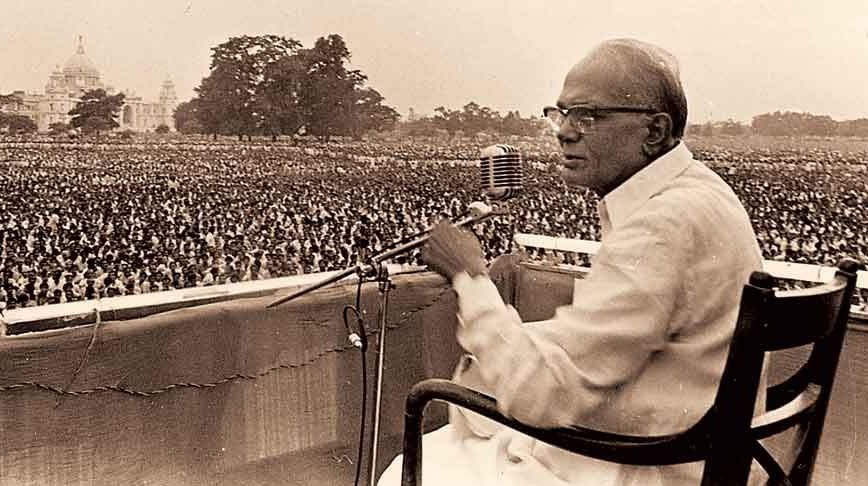
Seated at a microphone before a crowd filling a maidan to the horizon — the characteristic scene of the last two years of his life. A large domed memorial building is visible in the distance; the location is not recorded in the source file.
From a state agitation to a national crisis
Through the second half of 1974 the movement grew, and the government's response hardened. On 5 November 1974, during a procession in Patna, JP was struck by a police lathi; those around him, including the Jana Sangh organiser Nanaji Deshmukh, shielded him from further blows. He was seventy-two. The image of an elderly Gandhian being beaten in the street did more for the movement than any speech.
By early 1975 the agitation had become national. Opposition parties that had spent twenty-five years fighting each other began to coordinate around JP, who was not a member of any of them and was therefore acceptable to all of them.
On 12 June 1975 the Allahabad High Court set aside the Prime Minister's election from Rae Bareli on grounds of electoral malpractice and barred her from elected office for six years. The judgment turned a political movement into a constitutional crisis. On 25 June JP addressed a mass rally at the Ramlila Maidan in Delhi and called on the police and the armed forces to refuse orders that were illegal or immoral. That night the Emergency was proclaimed, and in the early hours of 26 June he was arrested.
What followed is set out in The Emergency.
The arguments against
Four criticisms, stated fairly
These were made at the time and are still made by historians. This archive sets them out with the responses rather than answering them on JP’s behalf.
That it was extra-constitutional
The charge: a government and a state assembly holding parliamentary majorities were being asked to resign because of street mobilisation. If a movement can unseat an elected government between elections, the argument runs, the electoral principle itself is undermined — and the appeal to the police and armed forces to disobey orders was an incitement to indiscipline in institutions on which the state depends.
The response: JP's position was that the right to petition, to assemble and to demand a fresh mandate is itself constitutional; that he asked for dissolution and elections, not for the seizure of power; and that his appeal was explicitly confined to orders that were unlawful, which no public servant is bound to obey. His critics reply that in a charged atmosphere the distinction does not survive contact with a crowd.
That it was vague
The charge: ‘Total revolution’ described everything and therefore specified nothing. A movement of that scale needed an economic programme, an organisational structure and a theory of who would carry it out; it had a slogan, a revered leader and a set of local demands.
The response: the movement did produce concrete work — the janata sarkars, the Vahini, the campaign against examination corruption — and JP argued that a movement's programme emerges from its practice rather than preceding it. It remains true that no worked-out programme for total revolution was ever published, and JP's own illness from mid-1975 removed the only person who could have written one.
That its social base was narrow
The charge: made most forcefully from the left. The movement's active core was students and the urban and rural middle classes, drawn disproportionately from upper castes. It attacked corruption and prices — grievances of people who have something — while land, caste and agricultural wages, the grievances of the very poor, stayed at the margins. In a state with Bihar's agrarian structure, that is a substantial omission.
The response: the Vahini did later take up land and caste questions in rural Bihar, and a generation of activists working on those issues came out of it. But that came after 1975, and the criticism of the movement at its height stands.
That it legitimised the Hindu right
The charge: the Jana Sangh and the RSS supplied a large share of the movement's organisational muscle. Working inside a movement led by a Gandhian socialist of unquestioned integrity gave them a national legitimacy they had not previously had, and a route into government by 1977. Several of JP's own associates warned him of this at the time.
The response: JP's position was that he would work with any organisation that accepted the movement's nonviolent and democratic discipline, and that excluding participants on the basis of their other affiliations was not open to a movement claiming to speak for the whole people. Whether that judgement was correct is one of the genuinely contested questions of modern Indian history, and this archive does not settle it. See Legacy.