Archival Gallery
Eighteen plates
Every item in this gallery is catalogued with what is actually known about it. Where a date, a place, a photographer or an identification is not recorded in the source, the entry says so. Nothing has been supplied to fill a gap.
Filter the catalogue
Select any plate to enlarge it. Images are displayed complete and are never cropped — faces, in particular, are always shown whole, which is why plates sit on a paper mount rather than filling their frame.
Studio portrait against a painted backdrop
A formal studio portrait, taken against the painted scenic backdrop common in Indian photographic studios of the period.
Painted portrait with crowd
A painted or drawn portrait in which the artist has placed sketched crowd faces behind the subject's shoulder.
Portrait in a dark kurta
A portrait from middle life, in the dark kurta he habitually wore for public occasions.
With Prabhavati Devi
JP with his wife Prabhavati Devi (1906–1973). The caption printed on the source reproduction reads “Jayaprakash Narayan and his wife”.
Portrait in a Gandhi cap
A close portrait from the years around independence, and the image most often used to represent him in that period.
An international socialist occasion
A conference occasion, the standing figure greeting the table with folded hands. The source file is titled “Jayaprakash Narayan attends the 8th SPD Party Congress, 22 May 1958, in Stuttgart”.
Speaking, against a dark ground
A later portrait catching him mid-argument rather than mid-address — hand at the chin, eyes away from the camera.
Seated, with a cup
An informal photograph from the years of the national movement: Gandhi cap, knitted waistcoat, a cup in both hands.
Colour portrait, later years
One of the few colour photographs in this set, from the later years — seated, in the white khadi of the constructive worker.
Before the microphones
In profile at a bank of microphones, the crowd stretching away behind him to the horizon. The characteristic image of his last years.
Addressing a mass meeting
Seated at a microphone on an open-air dais, addressing a crowd that fills the maidan. A large domed memorial building stands in the distance.
Composite: JP and Indira Gandhi
A publisher's composite placing the two central figures of the 1974–77 crisis side by side. It is not a photograph of them together.
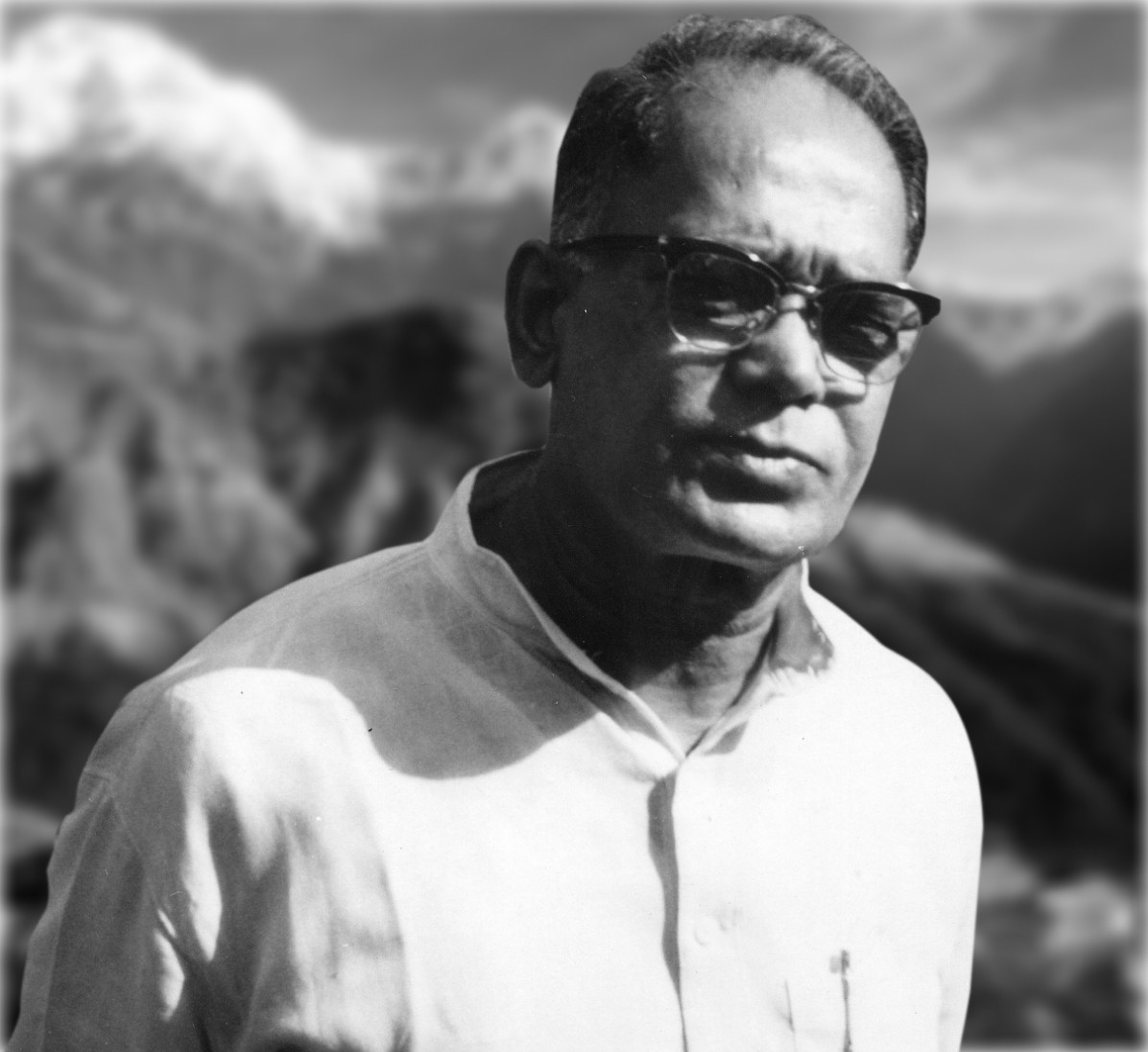
Close portrait, heavy spectacles
The high-contrast newspaper portrait by which most Indians of the mid-1970s would have recognised him.
Reading, reclining
Reclining on a bed with a sheaf of papers, an associate standing beside him and a wall of books behind. The occasion is not recorded.
Commemorative postage stamp
The commemorative stamp issued by India Post, carrying his name in Devanagari and Roman script and the dates 1902–1979. A postal cancellation runs across this used example.
Tribute before a portrait
A garlanded painted portrait of JP with a visitor bowing before it — an image of commemoration rather than of his lifetime.
Reading the newspapers
Seated at home with the newspapers, books stacked on the table beside him. The source file name refers to Patna.
Archival detail
A small, low-resolution cropped detail from a larger photograph. The source file is named as a crop from an image of Jawaharlal Nehru with Jayaprakash Narayan; the fragment alone is not sufficient for this archive to identify the sitter with confidence, and no identification is asserted.
On provenance and rights
The images reproduced here were supplied to this archive as a working set. For most of them the photographer, the date and the occasion are not recorded, and this catalogue says so rather than inventing plausible details — a habit that has done real damage to the visual record of the Indian twentieth century.
If you hold rights in any image on this page, or can supply documented information about a date, a place, an occasion or a photographer, the archive would be glad to hear from you and will correct or remove the entry. See Contact. Photographs are reproduced here for non-commercial historical and educational reference.